Pregnancy Disability Leave Administrative Guidelines
Introduction
The purpose of these guidelines is to provide clarification and guidance in the administration of Pregnancy Disability Leave (PDL) within the County of Sacramento. This document is intended to be an administrative guideline to help supervisors and managers administer provisions of PDL and it does not substitute for County Policy L-9 and County Code 2.78.765.
If there are any inconsistencies between the information contained in this administrative guideline and with County Policy L-9 and/or ordinance, the County Policy and Ordinance shall prevail.
Leave Entitlement
The leave can be taken before or after the birth as long as the leave is for a disability related to pregnancy, childbirth, or a related medical condition. The leave can be taken intermittently or continuously. Leave can include a reduced work schedule. The right to take four months of PDL applies to each pregnancy, regardless of frequency.
Disability:
It includes suffering from severe morning sickness, pregnancy complications, doctor ordered bed rest, childbirth, loss or end of pregnancy, and recovery from childbirth. Total incapacity is not required for PDL.
Medical conditions related to the female reproductive system are generally not within the definition of pregnancy, childbirth or related medical conditions, i.e. hysterectomy.
Leave for prenatal care is included in PDL.
Eligibility:
The employee is eligible starting on the first day of employment. Unlike FMLA/CFRA, there is no length of service requirement or requirement that an employee have worked 1250 hours prior to the commencement of the leave. An employee does not have to work full-time in order to be eligible. An employee does not have to be a permanent employee.
General Rule:
A pregnant employee may have the right to transfer to a different position for the duration of her pregnancy. A pregnant employee’s request to transfer to a different position (less strenuous or hazardous) must be based on the certification of her health care provider that the transfer is medically advisable. The County must grant the request, if it can be reasonably accommodated.
Example - Transfer: An Office Assistant (OA) who generally is on her feet all day requests a transfer to a sedentary OA position.
The County is not required to create additional employment, fire another employee, violate the terms of a collective bargaining agreement, transfer another employee with more seniority, or transfer or promote an employee who is unqualified for the new job. The County may accommodate a pregnant employee’s transfer request by transferring another employee, but there is no obligation to do so.
Alternative Position:
If the pregnant employee requests a transfer to another position and the employee's health care provider certifies that the employee is unable to perform her current job but could perform other duties, the County is required to temporarily transfer the pregnant employee if the transfer can be reasonably accommodated. In cases where a transfer is medically advisable, the alternative position must be one that better accommodates the medical needs of the employee than the employee's regular job. The employee must be qualified for the position. The employee who receives a medically advisable transfer is entitled to the same compensation and benefits in the alternate position as the employee received in her original position.
If the employee’s health care provider provides medical certification that she has a medical need to take PDL on an intermittent basis or work a reduced work schedule because of pregnancy the County may require the employee to temporarily transfer to an available alternative position that meets the needs of the employee. The employee must meet the qualifications of the alternative position. In such cases, the County may require that the employee transfer temporarily to an alternative position that better accommodates the employee’s leave requirements than the employee's regular job. The alternative position does not have to have equivalent duties, but the alternative position must have the same pay and benefits. For example, it may be necessary to increase the pay and benefits ordinarily associated with an alternative position, so as to make them equivalent to the pay and benefits of the employee's regular job. If an employee normally works a night shift which involves a pay differential and the County requires the employee to temporarily transfer to an alternative position that is on the day shift, the employee is entitled to continue to receive the night shift pay differential that she would have received in her normal position.
Right to Reinstatement after Transfer:
When the employee's health care provider certifies that there is no further medical advisability for the transfer, intermittent leave, or leave on a reduced work schedule, the employee must be reinstated to her same or comparable position.
Only the amount of leave actually taken will be counted toward the four months of PDL. To calculate the length of PDL an employee is entitled to count the days and hours the employee normally would work during the period of absence (note: holidays count as work days if taken within the week of PDL).
Example – 10/80 Full-time Employee, Four Months Continuous PDL:
The employee normally works 10 days per pay period, eight hours per day. The employee was absent for four months (17 and 1/3 weeks). During that absence, the employee is entitled to 86.6 days (693 hours) of PDL. There were two holidays during the four months and these days are counted in the 86.6 working days.
Example – 9/80 Full-time Employee, Four Months Continuous PDL:
The employee normally works nine days per pay period, nine hours for eight days and eight hours for one day per pay period. The employee was absent for four months (17 and 1/3 weeks) of PDL. During that absence, the employee is entitled to 86.6 working days (693 hours) of PDL.
Example – Half-time Employee, Four Months Continuous PDL:
The employee normally works five days per pay period, eight hours per day. The employee was absent for four months (17 and 1/3 weeks). During that absence, the employee is entitled to 43.3 working days (346.5 hours) of PDL.
Example – 4/5ths-time Employee, Four Months Continuous PDL:
The employee normally works eight days per pay period, eight hours per day. The employee was absent for four months (17 and 1/3 weeks). During that absence, the employee is entitled to 69.28 working days (554.4 hours) of PDL.
Variable Work Schedules – Including Part-Time Schedules
When an employee normally works a part-time schedule or variable hours, the amount of leave to which an employee is entitled is determined on a pro rata basis. If an employee’s schedule varies from week to week, a weekly average of hours worked over the 12 weeks prior to the beginning of the leave period would be used for calculating the employee’s normal workweek.
Holiday:
If a holiday falls within a week taken as PDL, the holiday is counted as a day of PDL.
Intermittent or Reduced Work Schedule:
PDL can be taken on a continuous basis or in small increments. PDL may be taken intermittently (i.e. for morning sickness early in the pregnancy followed months later by continuous time off for disability caused by childbirth). PDL may also be taken on a reduced work schedule basis when an employee is disabled because of pregnancy, as determined by the employee’s health care provider. The minimum leave increment is limited to the shortest time period used by the County's payroll system (.1 hour) to account for absences or use of leave. Only the amount of leave actually taken will be counted toward the four months of PDL.
Example - Intermittent Schedule:
A regularly scheduled doctor’s appointment two times per week for two hours per visit counts as four hours of PDL.
Example - Reduced Work Schedule:
If an employee cannot work for four hours per day due to pregnancy disability, those four hours are counted towards PDL.
Use of leave accruals:
Any time an employee is on PDL (whether or not also on FMLA), the employee can only be required to use sick leave balances (vacation, CTO and holiday-in-lieu are optional) before taking an unpaid leave.
Caution: To the extent there are any inconsistencies between the policy and administrative guidelines and existing memoranda of understanding covering employees in any representation unit created pursuant to Chapter 2.79 of the Sacramento County Code, the provisions of the memoranda of understanding shall prevail.
Request for Reasonable Accommodation:
There is also a general requirement to provide reasonable accommodation for an employee for conditions related to pregnancy, childbirth, or related medical conditions, if the need is confirmed by a certification of the employee's health care provider.
Example - Reasonable Accommodation:
A pregnant employee needs a footrest to elevate her feet.
Note: For further information or clarification on requesting a reasonable accommodation, employees should contact their supervisor/manager or HR Representative.
Relationship to FMLA:
Under FMLA, a pregnancy is a serious health condition for which leave may be taken. FMLA runs concurrently with PDL as long as the employee is notified within the proper time frame that her PDL is also being considered as FMLA leave. This means that the employee who uses all four months of PDL will exhaust her FMLA leave entitlement during her PDL.
- For a full-time employee, PDL time available is for a maximum of four months, or 86.6 working days, or 17 and 1/3 weeks, or 693 hours, of which 12 weeks, or 60 days, or 480 hours is concurrent FMLA.
- Four months is the maximum leave entitlement; however, the employee must be disabled for the entire PDL period because of pregnancy, childbirth, or related medical condition as certified by her health care provider, if required by the employer.
Relationship to California Family Rights Act (CFRA):
Under CFRA, an employee’s pregnancy is not considered a serious health condition of the employee for which CFRA leave may be taken, but a woman, who is disabled by pregnancy, childbirth or a related medical condition, is entitled to up to four months of leave under PDL law. PDL does not run concurrently with CFRA; they are two separate and distinct rights. Therefore, at the conclusion of PDL, the employee may still be eligible to take up to 12 weeks of CFRA leave to the extent that the CFRA leave has not previously been used in the 12-month period and the employee is otherwise eligible for CFRA leave. For a full-time employee, CFRA leave taken after an FMLA leave is for a maximum of 12 weeks/60 days/480 hours.
When an employee has used all four months of PDL before the birth of a child, and her health care provider determines that a continuation of leave is medically necessary, the County may but is not required to allow an eligible employee to use any available CFRA leave before the birth of the child for her own disability. The County is not required to provide more CFRA leave than the amount to which the employee is otherwise entitled (maximum of 12 weeks). If the child has been born by the end of the four months of PDL, the employee may take “baby bonding” CFRA leave, if she has not previously exhausted CFRA leave entitlement time.
The maximum entitlement for an employee, provided she qualifies for CFRA leave, for both pregnancy disability leave and CFRA leave for reason of the birth of the child and/or the employee’s own serious health condition is the working days in 29 1/3 workweeks. This assumes that the employee is full-time, disabled by pregnancy for four months (the working days in 17 1/3 weeks) and then requests, and is eligible for a 12 week CFRA leave for reason of the birth of her child.
CFRA eligibility period following PDL:
To be eligible for CFRA baby-bonding leave after PDL, the employee must have worked 1250 hours during the 12-month period preceding the first day of her PDL.
Relationship of PDL to Workers’ Compensation:
Example - Total Temporary Disability:
PDL runs concurrently with the workers’ compensation leave. If an employee is on a total temporary disability workers’ compensation leave and becomes disabled because of pregnancy, the employee remains entitled to workers’ compensation benefits as long as the health care provider certifies continuing workers’ compensation disability.
Example - Partial Temporary Disability:
If an employee is on a partial temporary disability workers’ compensation leave (i.e. working four hours per day) and becomes disabled because of pregnancy, the employee is entitled to PDL for the four hours the employee was working and remains entitled to partial temporary disability workers’ compensation benefits for the remaining hours.
Relationship to County Parental Leave:
Only a regular County employee, with at least one year of continuous employment, is eligible for County Parental Leave. For County Parental Leave, an employee is entitled to up to 160 hours of paid leave upon the birth or adoption of a minor child.
County Parental Leave is pro-rated for part-time employees.
County Parental Leave runs concurrently with any leave under FMLA/CFRA to care for a new child. County Parental Leave must be approved when it is used in conjunction with FMLA/CFRA. If FMLA and CFRA have been exhausted, or the employee is not eligible for FMLA or CFRA, County Parental Leave may be approved except where the granting of the County Parental Leave request would unduly interfere with or cause severe hardship upon department operations. Wherever possible, departments must make reasonable accommodations to permit County Parental Leave, whether on a full-time or part-time basis.
County Parental Leave is separate and distinct from the use of sick leave for pregnancy, since it is not based upon disability. County Parental Leave is available to be scheduled at the conclusion of the use of sick leave for pregnancy-related disability. For more information see the County Policy and Procedure L-7, County Parental Leave.
Relationship to State Disability Insurance (SDI):
There are separate eligibility criteria for SDI benefits. Eligible employees are entitled to apply for SDI which may be integrated with use of county leave balances.
SDI information packets are available from departmental payroll/personnel specialist.
Relationship to State Paid Family Leave Benefits (PFL):
Examples of Leave and/or Benefit Entitlements:
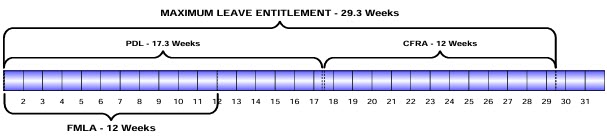
Maximum Leave Entitlement Diagram shows an employee taking the maximum time granted under PDL (four months = 17 weeks, three days) followed by CFRA leave (12 weeks) for baby bonding, for a total of 29 weeks, three days. CFRA does not run concurrently with FMLA / PDL in this case.
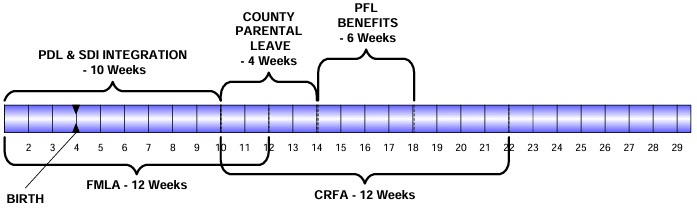
Scenario 1: Your full-time employee has notified you that her doctor has taken her off work the last four weeks of her pregnancy. She has not used any of her FMLA/CFRA entitlement prior to the pregnancy. She is entitled to up to four months of PDL. She uses four weeks prior to the birth and is entitled to six weeks after the birth for a natural delivery. Her SDI & PDL run concurrently. Your employee is also entitled to 12 weeks of FMLA which runs concurrently with SDI & PDL. The four weeks of County Parental Leave begins after her SDI and PDL end. Her 12 weeks of CFRA also begins at the same time as her County Parental Leave. Your employee’s 12 weeks of FMLA overlap with County Parental Leave & CFRA. The employee is entitled to six weeks of State PFL benefits for baby bonding which begins after County Parental Leave and runs concurrently with CFRA. The total time off is 22 weeks in this scenario.
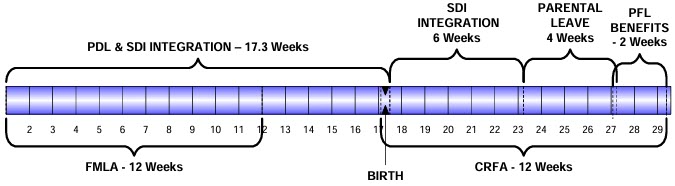
Scenario 2: Your full-time employee has notified you that her doctor has taken her off work the last four months of her pregnancy. She has not used any of her FMLA/CFRA entitlement prior to the pregnancy. She is entitled to 17 weeks, three days of PDL, of which 12 weeks of FMLA are running concurrently. Once the baby is born, she is ordinarily entitled to six weeks of SDI for a natural delivery. Because she has exhausted her PDL prior to the birth of her child, her CFRA begins at the birth and runs for 12 weeks. Your employee is entitled to four weeks of County Parental Leave after the six weeks of SDI. County Parental Leave runs concurrently with CFRA. The employee has requested six weeks of State PFL benefits for baby bonding, however, the supervisor only authorized leave through the remaining CFRA entitlement period. As such, the employee may only receive two weeks of State PFL insurance benefits which begins after County Parental Leave and runs concurrently with CFRA. The total time taken in this example is 29 weeks and three days.
The employee must request a leave but need not specifically mention PDL in order to be eligible for PDL. If the PDL qualifies as FMLA, the County must respond within two calendar days. If FMLA is not applicable, the County must respond in writing to the leave or transfer request as soon as practical and no later than 10 calendar days after receiving the request.
Example - Notification:
The employee calls and says that she is having morning sickness and needs to stay home for two hours in the morning every day. She will bring in a doctor’s note. The County must respond to the request within two calendar days if the leave would also qualify as FMLA. The employee does not need to bring a doctor's note each time she takes leave for morning sickness.
Leave forms and checklists can be found on the the intranet Department of PersonnelServices HR Forms page, this is an internal site, log in via VPN to access the site.
You may also contact your department human resources office to request a form.
Any certification for PDL must include the date the employee became (or will become) disabled due to pregnancy, birth or a related medical condition, the probable duration of the disability. The County must accept a complete medical certification as sufficient. However, for prenatal care visits, a health care provider’s note is sufficient.
Any certification for temporary transfer must contain the date the transfer became medically advisable, the probable duration of the transfer, and a statement explaining that the employee's transfer is medically advisable because of her pregnancy.
Failure to Provide Medical Certification:
Failure to Provide Medical Certification: In the case of a foreseeable need for reasonable accommodation, transfer, or pregnancy disability leave or recertification, the County may delay granting the reasonable accommodation, transfer or leave to an employee who fails to provide timely certification after the County has requested such from the employee (i.e. within 15 calendar days, if practicable), until the required certification is provided. If an employee fails to provide a medical certification within a reasonable time, the County may delay the continuation of the reasonable accommodation, transfer or pregnancy disability leave.
The County's certification form can be found on the intranet Department of PersonnelServices HR Forms page, this is an internal site, log in via VPN to access the site.
You may also contact your department human resources office to request a form.
When an employee uses accrued leave balances during PDL, her health, dental and life insurance are maintained by the County. It is the employee’s responsibility to contact the Benefits Office for details on reenrollment upon her first day of returning to work in order to avoid any unnecessary lapse in coverage.
If an employee is eligible for FMLA leave, but exhausts all applicable leave balances, the County will continue to pay the employer portion of the health, dental and Basic Life insurance benefits premium cost during the FMLA leave. The employee is required to pay her regular employee portion toward medical coverage. In order to continue Optional life insurance coverage, the employee must pay the entire premium. When paid leave and FMLA are exhausted, the employee’s benefits will continue through the end of the month.
If an employee takes unpaid PDL and is not eligible for FMLA or has exhausted the FMLA entitlement, the County continues to provide health, dental and Basic Life insurance benefits during the PDL at the same level that was provided prior to PDL, for the duration of the PDL, but not to exceed 4 months, as long as the employee continues to pay her portion of the premiums. In order to continue Optional life insurance coverage, the employee must pay the entire premium.
Once the FMLA and PDL benefits are exhausted, the employee is eligible to continue her health, dental and life insurance benefits under the provisions of COBRA. The County will notify employees of eligibility for COBRA rights upon learning of unpaid absence without benefit protection such as under FMLA, CFRA or PDL.
It is the employee's responsibility to contact the Employee Benefits Office prior to her return to determine what is required to reinstate her benefits. When an employee returns from PDL, she must receive the same health, dental, Basic and Optional Life insurance benefits as before the leave, with no new qualification period, physical examination requirement, or exclusions for pre-existing conditions.
After granting the PDL or temporary transfer, the County must reinstate the employee to the same position, or, in certain circumstances, to an available comparable position. This right must be guaranteed in writing upon the employee's request.
Right to Reinstatement to the Same Position
There are only two exceptions to an employee's right of reinstatement to the same position:
- There is no right to reinstatement to the same position if an employee would not otherwise have been employed in the same position at the time reinstatement is requested for legitimate business reasons unrelated to the employee taking a pregnancy disability leave or transfer (such as layoffs)
;-or- - The County may not rely on business necessity under the following circumstances: the job duties of the employee on PDL were distributed to other employees who could handle the additional workload; a temporary employee was hired as a substitute and did a better job.
Right to Reinstatement to an Available Comparable Position:
If an employee returning from PDL cannot be reinstated in the same position, the County must reinstate the employee to an available comparable position. A comparable position is deemed to be available if it is open on the employee’s scheduled return date, or within 60 calendar days thereafter. The employee must be qualified for the position.
A comparable position is one that is virtually identical to the employee's position held prior to reasonable accommodation, transfer or disability leave in terms of pay, benefits and working conditions. It must involve the same or substantially similar duties and responsibilities, which must entail substantially equivalent skill, effort, responsibility, and authority. It must be performed at the same or geographically proximate worksite of the employee’s prior position. It ordinarily means the same shift or the same or an equivalent work schedule.
The County has the duty to provide notice of available positions to the employee by reasonable means to inform the employee of comparable positions during the requirement period. Examples include notification in person, by letter, telephone or email, or by links to positions on the County’s website.
There are only two circumstances in which the County may be excused from reinstating the employee to a comparable position:
- The County would not have offered a comparable position to the employee if she would have been continuously at work during the pregnancy disability or transfer period.
- There is no comparable position available.
If PDL is also an FMLA leave of 12 weeks or less, the FMLA reinstatement requirements apply, i.e. an employee must be reinstated to an equivalent job. See FMLA/CFRA Policy L-9.
If an employee disabled by pregnancy remains on some form of leave following the end of her pregnancy disability leave, the County must grant the employee reinstatement rights that are the same as any other similarly situated employee who has taken a similar length disability leave. For example, if the County grants reinstatement to other employees who are temporarily disabled for six months, the County must also grant reinstatement to an employee disabled by pregnancy for six months. The County and employee may also agree to a later date of reinstatement.
Reinstatement when CFRA Leave follows PDL:
If an employee takes CFRA leave immediately following a pregnancy disability leave, without returning to work, the CFRA governs the employee's reinstatement rights. See FMLA/CFRA Policy L-9.
Employment Home
Equal Employment Opportunity
Examination and Certification
Pre-Employment Reviews
Drug-Free Workplace
Appointment
Compensation
Employee Benefits and Insurance
Leave Administration
Work Schedules
Training
Travel/Relocation
Employee Recognition
Employee Relations
Retirement
Layoff
Position Control and Employee Files
Risk Mgt/Health and Safety
Pregnancy Disability Leave Policy Information
Section:
Employment Policies
Subsection:
Leave Administration
Authorized by
Navdeep S. Gill, County Executive
Resources
Contact
Policy and Compliance Administrator
Department of Personnel Services
Email: AskDPS@saccounty.gov